
Pay standstill for you and increases for others as the economy shows signs of recovery
Your salary has shown virtually no growth…but call centres are starting to consider increasing staff numbers. Lois Wiggins, of Incomes Data Services, has this exclusive report on IDS’ 14th call centre survey
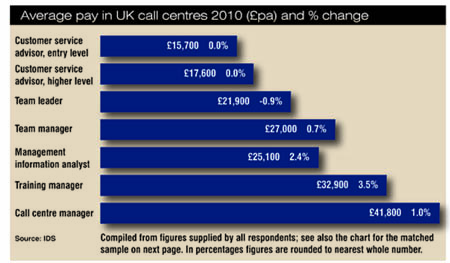
GROWTH in pay has been flat over the past year for most call centre jobs. However, there have been increases for senior customer service advisors and for roles which are focussed on driving business performance, including training managers and information analysts.
This year, our survey was
conducted during a period of cautious economic recovery after a sharp focus by
many employers on cost control in 2009. The economic downturn led to heightened
job insecurity and -- in line with this -- employers reported less difficulty
with recruitment and retention and a drop in turnover and absences. As the
economy shows signs of recovery, however, firms are having to re-engage with
their employees and focus on the measures required to retain key staff.
Minimum salary levels have shown the most growth, while maximum salary levels have remained flat. This is in response to growing recruitment problems, though staff retention continues to be less of a problem compared to last year.
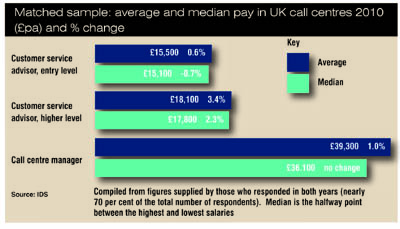
Matched sample Nearly seven out of 10 (68 per cent) of companies that replied to this year’s survey were also respondents in 2009, creating a robust matched sample. Our analysis presents a clearer view of what has actually happened to pay and supports the findings of the overall survey results. They show that there has been very small growth for salary levels for entry-level CSAs, with most organisations making adjustments to minimum salaries, while maximum salaries have stayed at 2009 levels. However, according to the matched sample analysis, there has been stronger pay growth for senior CSAs over the past year.
Perhaps unsurprisingly given the recent economic downturn, the large majority of respondents told us that recruitment is currently not a problem
According to the matched sample, minimums of pay ranges for entry level CSAs have increased by 2.2 per cent at the median, from £13,500 to £13,800 in 2010. This is ahead of the growth rate of 1.5 per cent monitored in the survey as a whole. Maximum salaries in the matched sample show a decline, with a median maximum salary of £17,000 in 2010, compared to £17,800 in 2010.
Call centre managers’ salaries have shown little growth over the past year, and the matched sample analysis confirms this finding. While there is slight growth in the average salaries for call centre managers, the median figures show pay growth is flat. Like other call centre roles, there has been some small growth for minimum salaries, while maximum salaries have actually fallen back.
Senior CSAs Data on pay levels for senior CSAs in the matched sample shows that there has been stronger growth compared to that for entry level CSAs over the past 12 months. Median midpoint salaries for senior CSAs have grown by 2.3 per cent from £17,400 in 2009 to £17,800 in 2010. Average midpoint salaries have shown slightly more growth, with salaries increasing by 3.4 per cent to £18,100 in 2010.
Improving business performance Pay for training managers and information analysts -- roles focussed on improving business performance -- have both shown some growth over the last 12 months. This year’s survey shows that salaries for management information analysts have grown by 2 per cent since 2009. At the median, the midpoint salary has increased from £24,500 to £25,100 this year. Most of this growth has taken place at the minimum of pay ranges where our survey findings show there has been growth of around 7 per cent year-on-year. Maximum salaries have also risen, but less than minimum salaries.
Pay levels for training managers have also grown over the past year. The average midpoint salary for this role is £32,900 in 2010, up from £31,800 in 2009, growth of 3.5 per cent. At the median, the midpoint salary is £31,000, which is actually down on the salary recorded a year ago but one explanation for the average salary being higher is the number of higher salaries for training managers in our sample this year. Salaries for this role vary widely, ranging from £23,000 to £55,825 a year.
Trends This year’s survey results show that the recent economic downturn is still having an impact on retention, turnover and absence rates in call centres, while the picture on recruitment is changing slightly. It appears that the uncertainty about the economic recovery is still affecting staff who are keen to hold on to their jobs, while employers are starting to consider increasing staff numbers and are often finding recruitment more difficult than last year (see below).
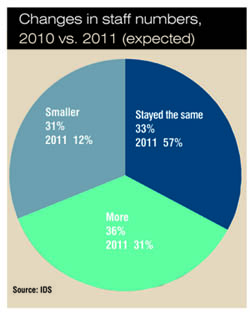
Around 36 per cent of respondents told us that they had hired more people over the past year. Most of these companies are in the private services sector and they cited that an increase in new business was the reason for growth. However, the proportion of respondents reporting a contraction in their workforce numbers over the past year – while lower than last year -- is still significant at 31 per cent. Many of the organisations that have reported a contraction are in financial services and most of the reasons they quoted related to restructuring and cost reduction targets.
Recruitment and retention Perhaps unsurprisingly given the recent economic downturn, the large majority of respondents (60 per cent) told us that recruitment is currently not a problem. However, the overall proportion of organisations who say that they find recruitment difficult has grown since last year, perhaps reflecting a recovery in the industry. Around 38 per cent of respondents said they find recruitment “fairly difficult”, while 2 per cent said they find it “very difficult”. The role most affected by recruitment difficulties is CSAs.
The picture on retention remains similar to last year, with around 74 per cent of survey respondents telling us retention is not currently a problem. However, concerns about staff retention are growing. The proportion of organisations where retention is currently “fairly difficult” has increased from 16 to 21 per cent.
Turnover continues to fall The average staff turnover rate has fallen to 16 per cent over the past year, down from 19 per cent last year and 23 per cent in 2008. This is linked to the economic climate and the trends around retention, with staff tending to hold on to their jobs in an environment where there are still concerns about job security. Those respondents who described retention as either “very difficult” or “fairly difficult” had a higher average staff turnover rate, at 23 per cent.
For the purposes of the survey, the annual rate of staff turnover is defined as the number of voluntary leavers as a percentage of the workforce. Overall, reported turnover rates, excluding agency staff, ranged from just 1 per cent to 39 per cent.
Sectors with the highest reported staff turnover are financial services at 21 per cent, “other private services” (19 per cent) and retail (18 per cent). Among the organisations in the leisure and travel and outsourced services sectors, staff turnover is at or below the overall average.
Compared to a year ago, just under half (49 per cent) of all respondents said that staff turnover had fallen; 46 per cent said it was the same; and a very small minority (5 per cent) said that turnover had increased.
Pay settlements The median pay increase for call centre workers over the last 16-month period is 1.5 per cent. This covers the period between April 2009 and July 2010, a time of economic volatility and fluctuating levels of inflation. Pay settlements in call centres are behind those monitored across the wider economy where the median settlement level over the same period is 1.9 per cent.
Almost a fifth of call centre staff had no increase in the last 16 months; in the whole economy almost a third of settlements resulted in no across-the-board increases.
Last year, the median pay settlement level in call centres was 2.8 per cent which is relatively high considering most of these pay awards took effect during the recession. However, last year’s survey analysed settlements in the period from April 2008 to July 2009, at a time when there were still relatively high levels of inflation, which produced an upward pressure on pay awards.
Pay progression for CSAs Around a fifth of organisations in the survey operate spot rates of pay for CSAs. Nearly all of these companies said that the rate was based on the local labour market. However, the majority of organisations have salary ranges through which agents progress. Most companies use a combination of measures as a basis for progression through pay ranges. Most of these “hybrid” systems use performance as the main criterion for progression, but with the addition of skills or competencies as extra criteria.
Half of respondents told us that pay progression operates differently for more senior staff than for CSAs. Looking at those organisations where pay progression operates differently it was usually the case that progression for agents was based on a hybrid system with service-related increments plus individual performance or skills acquisition, whereas, in most cases, progression for more senior staff was based solely on performance.
Bonuses Some 83 per cent of organisations in this year’s survey told us they operate a bonus scheme, of which almost all were private sector companies. The median bonus in this year’s survey was £1,000 annually (average: £1,359) for lump sum bonuses, and 8.4 per cent for schemes based on a percentage of salary. Individual performance remains the most common criteria for judging the level of bonus awards, with 57 per cent of organisations that paid bonuses doing so on this basis.
 PROFILE
Lois Wiggins, senior researcher, Incomes Data Services, has worked on the fortnightly IDS publication Pay Report for four years and has responsibility for analysing latest pay settlement levels across the economy. She leads research and analysis for the annual IDS publication, Pay and Conditions in Call and Contact Centres, and conducts the yearly survey of pay and conditions in local government. Ms Wiggins has been involved in a number of contract research projects including work for the Office of Manpower Economics on Pay Reviews in a Recession.
About the survey
Pay and Conditions in Call and Contact Centres 2010/11 (91pp, 26 charts) is the 14th annual survey carried out by Incomes Data Services and the research was carried out in the summer of 2010.
The survey covers 104 call centres across the UK, which employ a total of 38,000 staff. Respondents included those in retail, financial services, outsourced services, leisure and travel, telecoms and utilities, not-for-profit and the public sector.
The most heavily represented region in this year’s survey is the North West, where a fifth of call centres recorded are based. The second-highest concentration of call centres was found in Scotland (17 call centres) and the next highest in Yorkshire and Humberside (16 call centres).
The report contains details of salaries for agents (entry level and experienced), team leaders and managers, management information analysts and training managers. It also looks at bonus payments, pensions and hours and holiday entitlements. The report covers details on the latest labour market trends in call centres including staff turnover, absence and recruitment and retention issues. As well as analysis by industry sector, it gives details of pay by region.
More information about the report is at www.incomesdata.co.uk.
Readers can order Pay and Conditions in Call and Contact Centres 2010/11 for £249 – a £50 discount on the full price. Call IDS customer services on 0845 600 9355 and quote code 0095305A.