Pay rise
for you and more agents are on the way, says new study
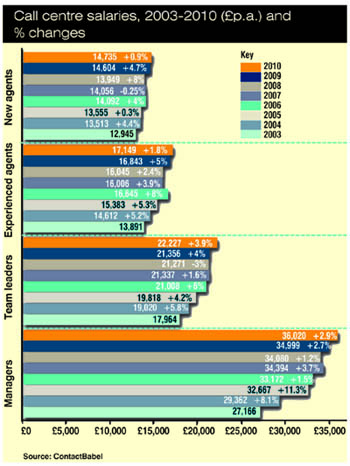
AVERAGE pay for call centre managers has increased by nearly three per cent to
£36,020, says a new study. However, salaries vary widely depending on region,
type of operation and industry sector.
In
London, managers can expect to earn £44,300 while those in East Anglia and
Northern Ireland report salaries which are £13,000 lower. And those in
financial services earn £11,000 more than those in outsourcers.
The
figures are from the eighth edition of The UK Contact Centre Decision-Maker's
Guide, an annual report by ContactBabel, based on its survey of 205 call
centres.
Respondents expect to hire more people in the next 12 months, an average
reported growth of 6.8pc. Those who expected more recruitment totalled 44pc
against 19pc expecting a further decline.
And
the average induction course has risen by 60pc to £1,900.
The
report's author, Steve Morrell, said: “It is often said that the first cuts to
be made in a recession are in training and marketing budgets, as the negative
results of these will be felt sometime in the future rather than immediately.
The 2009 training budget figures bore that out, with a dramatic drop in training
expenditure, but this trend seems to be in reversal now.
“In
terms of expected agent growth figures for 2011, public sector respondents are
unsurprisingly the least bullish, along with the transport & travel and
utilities sectors. The majority of retail and distribution, outsourcing,
finance, telecoms, media, technology and services respondents expect significant
increases in headcount.”
 Most
call centres have seen a decline in attrition, from 24pc to a new low of 16pc,
as people become more fearful for their jobs, and opportunities elsewhere dry
up. As in previous studies, large call centres suffer the highest attrition,
at an average of 29pc. Those with fewer than 50 seats report an average
attrition figure of 10pc.
Mr
Morrell cautions: “The recession has reduced attrition greatly over the past two
years, but contact centres must understand that this is nothing more than a
temporary respite.
“With no structural change to the industry, its recruitment and training
methods, management techniques or job types, the same problems will emerge as
the economy picks up, and anecdotally, attrition rates are said to be increasing
again.”
“In
fact, the seeds of attrition are sown before the agent even starts work. With
many contact centres reporting attrition in the first three months to be over
50pc of their annual staff turnover, and the most popular explanation for an
agent leaving the role is that they were temperamentally unsuited to the job, a
case can be made that attrition is actually a problem caused by the recruitment
process.”
Email now accounts for 10.2pc of all customer-to-business communications, with
86pc of call centres now accepting customer emails. It is most used by retail
and distribution (17.1pc) and telecoms, media and technology (15.9pc).
Perhaps due to the confidential nature of most customer enquiries, the finance
sector is by far the least likely to use email communications (2pc).
Telephone use stands at 83pc, comprising 77pc handled by live agents and 6pc by
self service.
Mr
Morrell said: “Email response handling times have shown a slight improvement on
2009, with the proportion answered within one hour going from 10pc to 12pc, and
those answered the same working day going from 35pc to 44pc.
“However, taking longer than one day to answer an email runs the risk of the
customer losing patience, leading them either to phone the contact centre --
with the attendant extra cost to the business -- or worse, go to another company
entirely.
“It
is very concerning that the retail and distribution sector has the greatest
proportion of respondents taking longer than 24 hours to answer an email (48pc),
perhaps as a result of the higher-than-average volumes that the sector receives.
“Many of these emails will be sales-related, and the poor performance is
exacerbated by the relatively low levels of investment in email systems in many
retailers.”
He
suggests investment in modern email management systems or the use of a third
party.
Another suggestion is a “text chat” box to aid customers buying from web sites.
Mr Morrell says that having the ability to immediately clarify a point – such as
the exact product specification or delivery times – with an online agent could
make the difference between winning and losing a sale.